
Development Direction of Small-Part Warehouse Automation: Tote-Based Mini AS/RS
The Core Development Trend: From Equipment-Centric to Tote-Centric Design
The primary development direction in small-part warehouse automation is no longer defined solely by speed or height, but by the standardization of the handling unit itself. For manufacturing enterprises managing raw materials, e-commerce warehouses handling multi-SKU piece picking, and pharmaceutical facilities requiring batch traceability, successful automation depends on treating the tote as the foundational design constraint. Guangermei’s approach to tote-based mini AS/RS reflects this shift, prioritizing container integrity and workflow alignment over theoretical throughput metrics.
Critical Prerequisites for Stable Automation
To avoid common implementation failures, small-part automation projects must address three foundational elements before hardware selection:
1. Container Standardization and Verification
Automation reliability is determined by the physical compatibility of the storage unit. Unlike palletized goods, small items rely entirely on secondary containers. Key verification criteria include:
- Dimensional Consistency:*
- Systems should be designed around standardized tote references. Guangermei’s standard tote specifications are 550 mm × 365 mm × 210 mm or 330 mm in height. Non-standard dimensions must be explicitly marked as "verified per project" to prevent jamming or retrieval errors.
- Load Capacity Validation:*
- Single-tote weight limits must be confirmed against equipment ratings. Exceeding verified load capacities requires structural reinforcement and affects stacker crane sizing.
- Physical Integrity:*
- Bottom rigidity and stacking strength must be validated under full-load conditions to ensure compatibility with high-speed stacker cranes and conveyor systems.
- Scannability:*
- Bin coding and barcode placement must align with fixed scanner positions at inbound/outbound stations to ensure accurate data capture.
2. Defined Information System Boundaries
A major bottleneck in automation development is undefined software responsibilities. Projects must establish a clear interface confirmation checklist covering:
- Inventory ledger synchronization between WMS and host ERP.
- Unique bin encoding logic compatible with WCS addressing.
- Inbound and outbound task triggering mechanisms.
- Cycle count and reconciliation protocols.
- Batch and expiry date tracking for regulated industries (e.g., pharmaceuticals).
- Clear responsibility boundaries distinguishing master data ownership from transactional commands.
Guangermei integrates this interface definition into the solution design phase to ensure software and hardware evolve in tandem, preventing isolated automation islands.
3. Right-Sizing Equipment to Actual Cycles
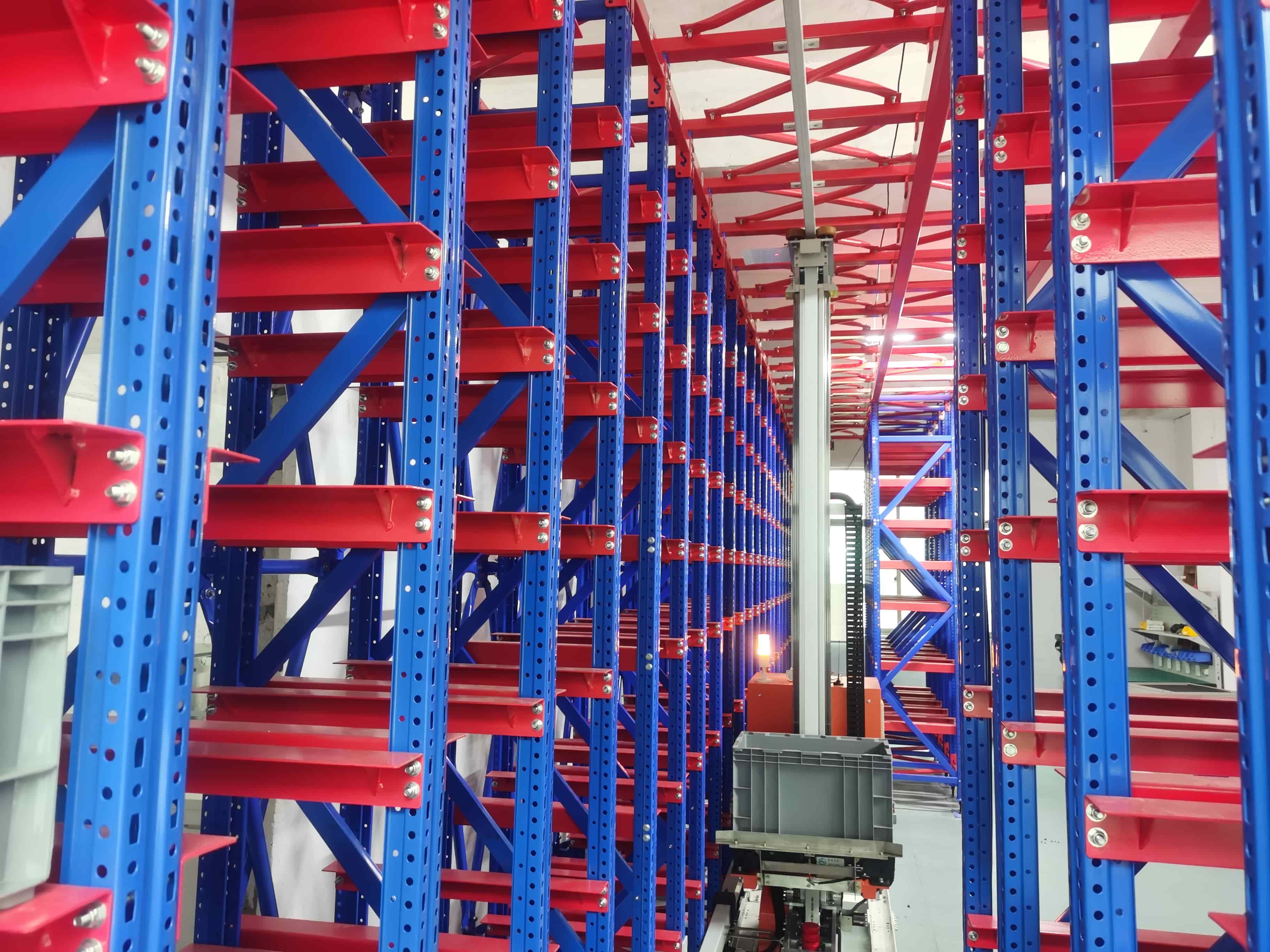
Sustainable automation avoids over-specification based on peak demand. Equipment configuration should reflect real business needs and site conditions. Guangermei’s standard miniload stacker crane reference dimensions are approximately 12,300 mm (L) × 2,070 mm (W) × 3,150 mm (H), supporting roughly 320 locations for 210 mm totes or 240 for 330 mm totes. This standardized footprint serves many mid-scale applications efficiently. Customization is available for specific site constraints, but only after baseline requirements are validated to ensure long-term stability and maintainability.
Applicable Scenarios and Execution Boundaries
This tote-based automation model is specifically suited for:
- Manufacturing Raw Material Warehouses:*
- Supporting production planning with kitting, replenishment, and returns management tied to work orders.
- E-Commerce Piece Picking:*
- Enabling goods-to-person workflows for high-SKU, low-cube items where pick accuracy directly impacts fulfillment SLAs.
- Pharmaceutical Storage:*
- Providing traceable, FIFO-compliant storage with integrated batch and expiry controls.
Execution Note: This approach is less appropriate for bulk commodities, irregularly shaped items without standardized containment, or operations with very low SKU counts where manual methods remain cost-effective. Food and daily chemical warehousing require additional validation of hygiene and material compatibility before deployment.
Implementation Recommendations
Enterprises evaluating small-part automation should begin with a container audit and interface mapping exercise. Essential preparation includes:
- Sample totes (including worn units from current operations) for physical testing.
- Current SKU list with dimensions, weights, and turnover rates.
- Existing WMS/ERP documentation outlining data fields and transaction flows.
- Floor plan with clear height, column spacing, and utility locations.
Guangermei supports this process with comprehensive services including demand analysis, solution design, equipment manufacturing and integration, installation and commissioning, operational training, and after-sales support—all centered on verified tote-level parameters.
Recommended
Miniload Stacker Crane AS/RS Solution
Using totes as the core storage and retrieval unit, combined with high-speed stacker cra...